NewstartPlus programme for university libraries
26. Jan. 2026 / Campus Living / Learning & Studying / Science & Research
We asked library director Raul Cervantes (M.A.) about the cornerstones of the NewstartPlus programme, which is being implemented at the Friedensau University Library:
How did the idea of applying NewstartPlus to the library in Friedensau develop?
With the rise of digital media such as e-books, e-journals, etc., and currently the topic of artificial intelligence (AI), libraries are being challenged to question their existence and relevance. This has given rise to trends such as ‘The Library of Things,’ which is no longer just about the classic services of a library, but a much broader approach. The significance of this could perhaps even be compared to how churches in some places are being converted into restaurants or museums.
And this is where the so-called ‘commons’ come into play: commons are shared and collective resources (such as knowledge) and freely accessible cultural assets (buildings, art). In future, libraries will not only lend books, but also provide other equipment and resources that help society to act effectively.
This trend is referred to as ‘The Library as Third Place’ and attempts to establish libraries as a third relevant place to spend time, after one's own home and workplace. In this way, the university library is attempting to reposition itself in a new and relevant way. It offers a counterbalance to readers who are no longer just online ‘on their own’ in their homes and no longer have a ‘real’ social life, but are once again participating in social life.
We, as the library team, asked ourselves: What can we do? Since the Free Church places a strong emphasis on ‘health and healthy living,’ we decided to go down this path. NEWSTARTPLUS in libraries is important to us; we want to establish it locally as a health concept and recommend it to our partner institutions.
Some may think that we don't need something like this. We see this as just the beginning, the ‘tip of the iceberg,’ so to speak—and there is great potential, especially in an academic environment. I think this is revolutionary and, at the same time, challenging for some because it challenges established patterns of thinking. In the future, the library wants to offer better technology and more comfort—as an experience, so to speak.
Which of the individual ‘pillars’ of the concept have already been implemented and which will follow in the coming weeks?
As already mentioned, the concept is being implemented in a fluid and dynamic manner. There are elements where we have already achieved significant progress (e.g. fitness applications), while others are still at the conceptual stage of development. It is not time-limited, so you couldn't say that everything has been completed. On the contrary, it never ends because new knowledge, new trends and new needs are constantly emerging, and the individual elements can be continuously developed and improved.
‘Measuring’ is only partially compatible with this concept. Evaluation can be useful for certain periods of time. However, the decisive factor for us is that we have started – and we are sticking with it. There are factors that influence the next steps. These are, of course, taken into account. With this in mind, we do not work with fixed deadlines, but with attentiveness. This determines the next steps.
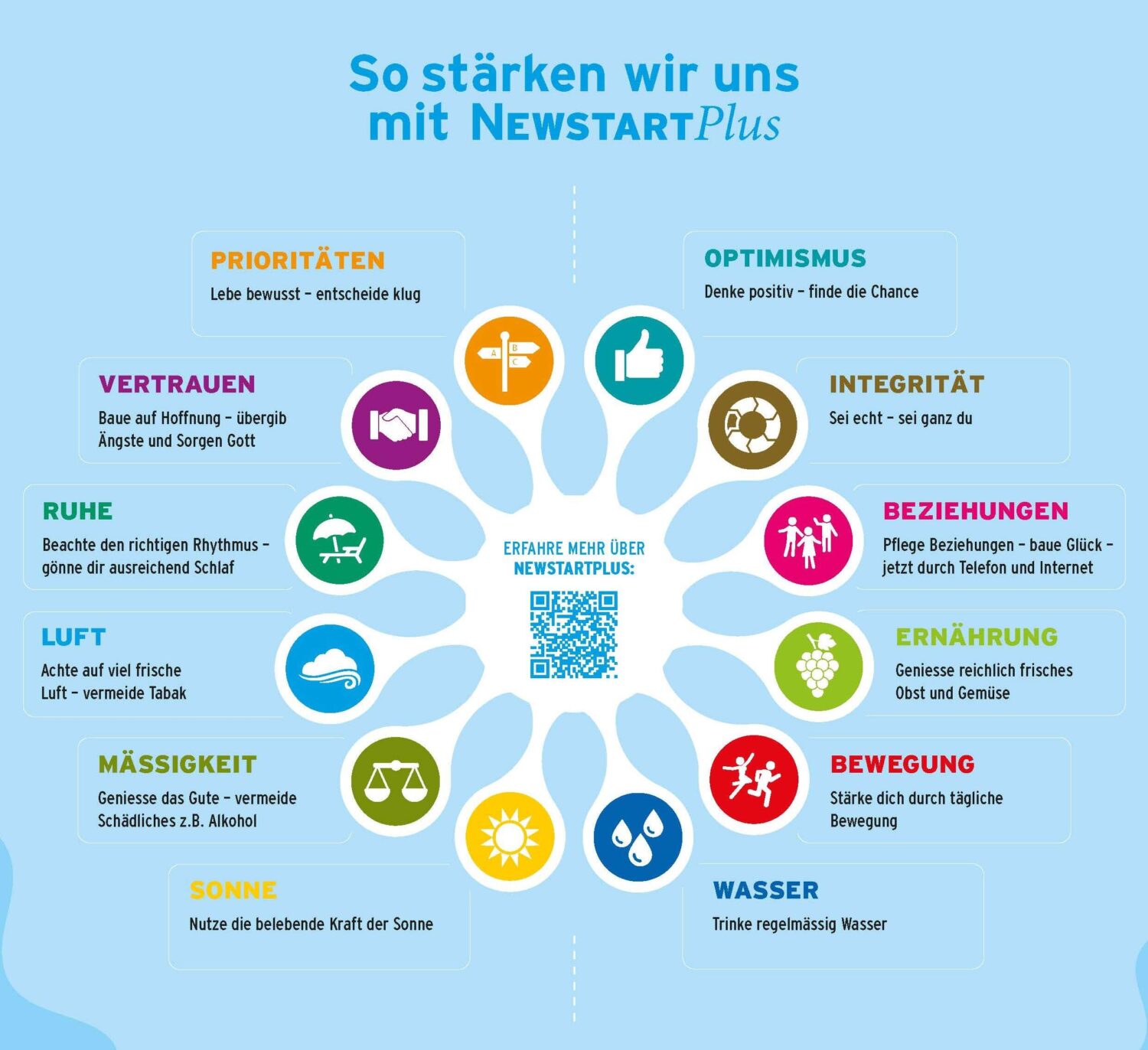
To make this tangible, here are all the elements of NEWSTARTPLUS as we implement them in everyday library life:
N – Nutrition: Through themed events, lectures and, for example, plant-based cooking courses, we address issues of healthy eating, mental performance and lifestyle awareness.
E – Exercise: We have set up a fitness corner with office-friendly equipment. It allows for short exercise sessions, muscle relaxation and posture improvement without having to leave the library.
W – Water: Drinking water (still, cold, sparkling) is available. In the summer months, we also plan simple water treatments such as foot or arm baths to help you cool off in the heat – low-threshold, but thoroughly therapeutic.
S – Sun/light: Through targeted lighting control and colour concepts, we adapt the atmosphere to the seasons and usage situations in order to support attention, mood and biorhythms.
T – Moderation & effectiveness: Offers on time management, self-regulation and productive learning are designed to help prevent overload and exhaustion.
A – Air: We use air purifiers in selected areas. In addition, we work with aroma diffusers to gently influence well-being and atmosphere – not clinical therapy, but consciously applied therapeutic impulses.
R – Rest: There are quiet zones, rooms for silence, prayer and rest breaks. We understand rest as a prerequisite for effective performance.
T – Trust & safe space: The library should be a safe, inviting place – a retreat and a reliable place in everyday study and research life.
The word ‘library’ is borrowed from Greek and can be translated as ‘book container’. Why should the ‘stars’ of a library (books, media, and even literary events such as readings) have to compete with health regulations in the future?
As the saying goes, one should not throw the baby out with the bathwater. Without neglecting the traditional services of a library, we want to evolve with the times. This is not about rules or competition, but about knowledge, cooperation and synergies. Together we are stronger than when we work in isolation.
Networking instead of isolated solutions
It is important to us to emphasise that we do not want to work in isolation with NewstartPlus. There are many initiatives on campus working towards similar goals, and we want to consciously create synergies. One example is the so-called ‘Friendship Bench’ service. Since the library has very long opening hours and is a familiar place to spend time, it makes sense to offer this low-threshold listening and conversation service here as well. Library staff are trained accordingly.
Gathering feedback and checking effectiveness
We also want to know what works and what doesn't. That's why we plan to conduct short surveys to gauge sentiment on a regular basis. We are working closely with colleagues from the social sciences who have experience in designing and conducting such surveys. This ensures that legal, ethical and data protection aspects are complied with.
Where this is all headed
First and foremost, the aim is to create a healthy, peaceful and inspiring learning, cultural and social environment on our campus. We also see NewstartPlus as a pilot project. If the approach proves successful, we would like to share it within the network of Adventist university libraries worldwide and, if there is interest, beyond.
Thank you for the interview – we wish you every success in implementing the project (questions asked by Andrea Camer).