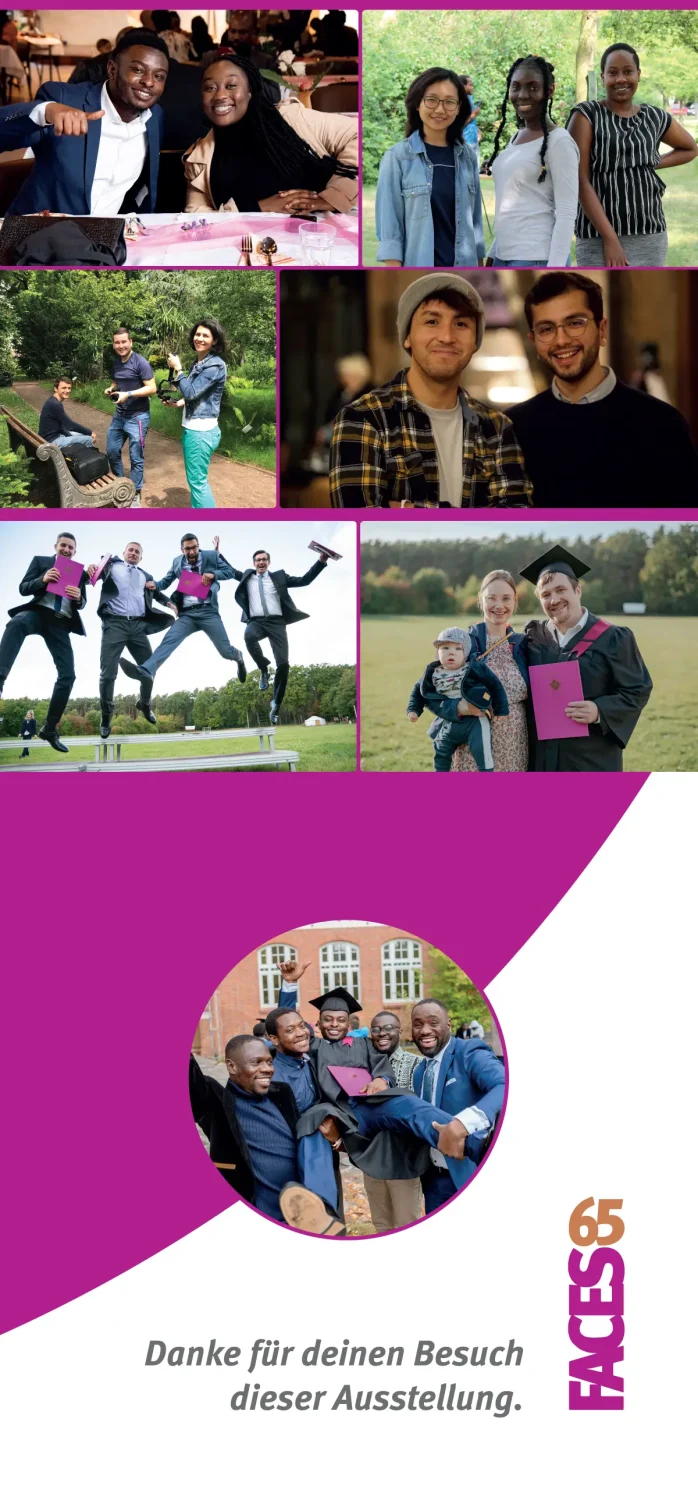
Gesichter. Faces | 1960 – 2025
The exhibition “Gesichter. Faces | 1960 to 2025” was created for the Alumni Reunion in October 2026, bringing together graduates from the early 1960s through to those who graduated in 2025. This explains the selection of school photographs – we begin with the year 1960.
The photographs are arranged by decade. They mainly show group photos and do not, of course, include all alumni. We ask for your understanding.
Friedensau is more than a municipality. Friedensau means community – a community shaped by years of study, shared faith and life together. Visitors who discover themselves, friends, relatives or ancestors in these photographs may realize that they represent a small building block, a small piece of the puzzle – or that they themselves are among those who have helped shape Friedensau. How wonderful that this connection has endured to this day. We hope that “Gesichter. Faces” has allowed us to trace the history of Friedensau through its people – even if the picture remains inevitably incomplete.
Even though much remains unmentioned: Take a moment to look back over the years and carry many encouraging memories in your heart!
Concept and design: Barbora Kaba | Photos: Historical Archive | Texts: Andrea Cramer and Dr. Johannes Hartlapp
Overall responsibility: FAU, Department of Marketing and Public Relations, and Library, with Dr. Inna Mayer and Raul Cervantes | Image editing: Nele Koch | Production: Eugen Mayer
Join in, Alumni!
Your experiences and memories
What did you experience during your studies in Friedensau? Was there something particularly important, funny or sad that you remember from your time here?
Take a piece of paper, write something down and hang it on the string so that we can share and remember it.
Fingerprint
Leave your fingerprint on this frame. Maybe it will become part of a new work of art!
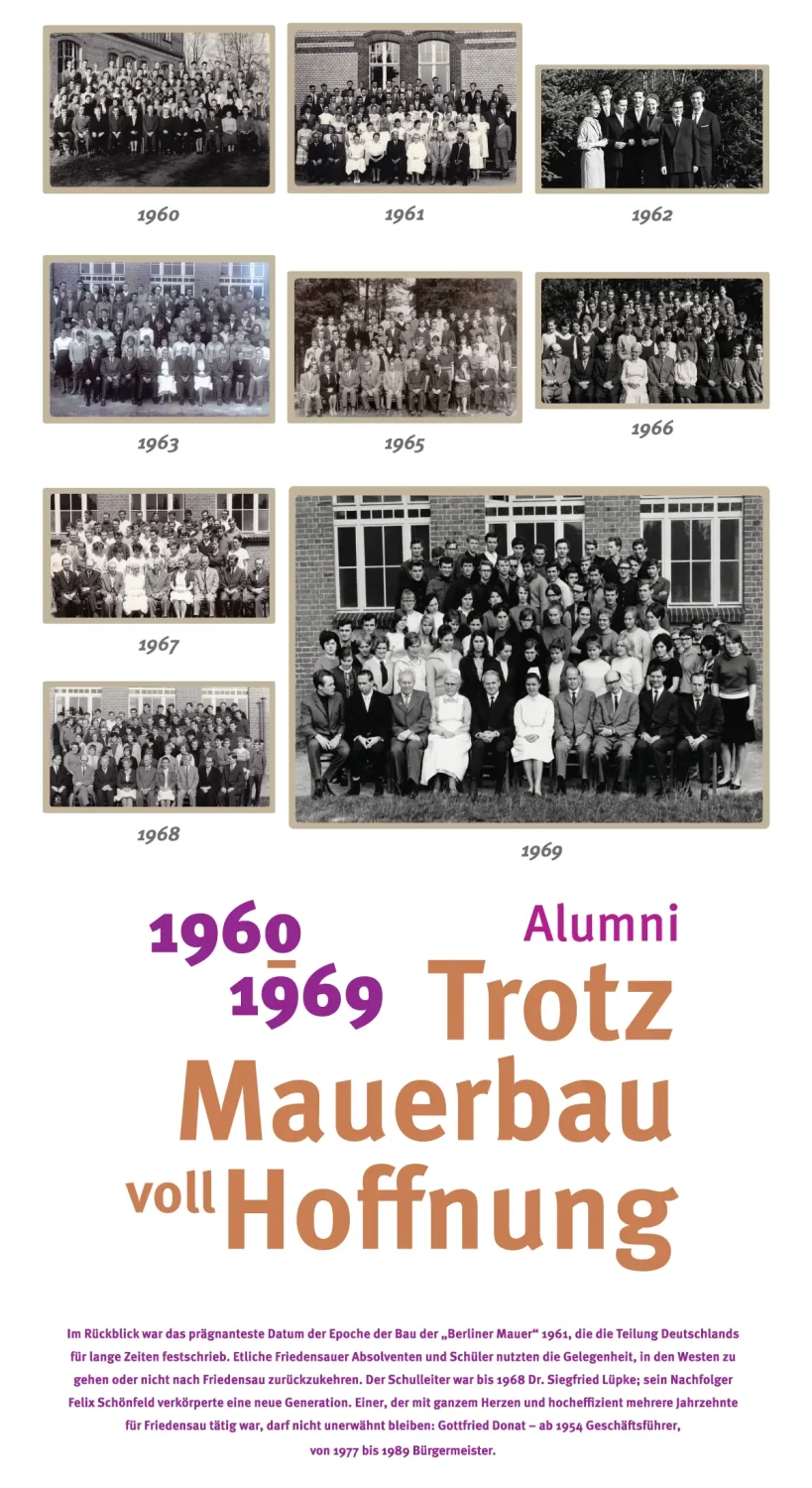
1960–1969
Despite the Construction of the Wall, a Time of Hope
Looking back, the most defining event of this period was the construction of the Berlin Wall in 1961, which cemented the division of Germany for many years. A number of Friedensau graduates and students took the opportunity to move to the West or chose not to return to Friedensau. Dr. Siegfried Lüpke served as head of the school until 1968; his successor, Felix Schönfeld, represented a new generation.
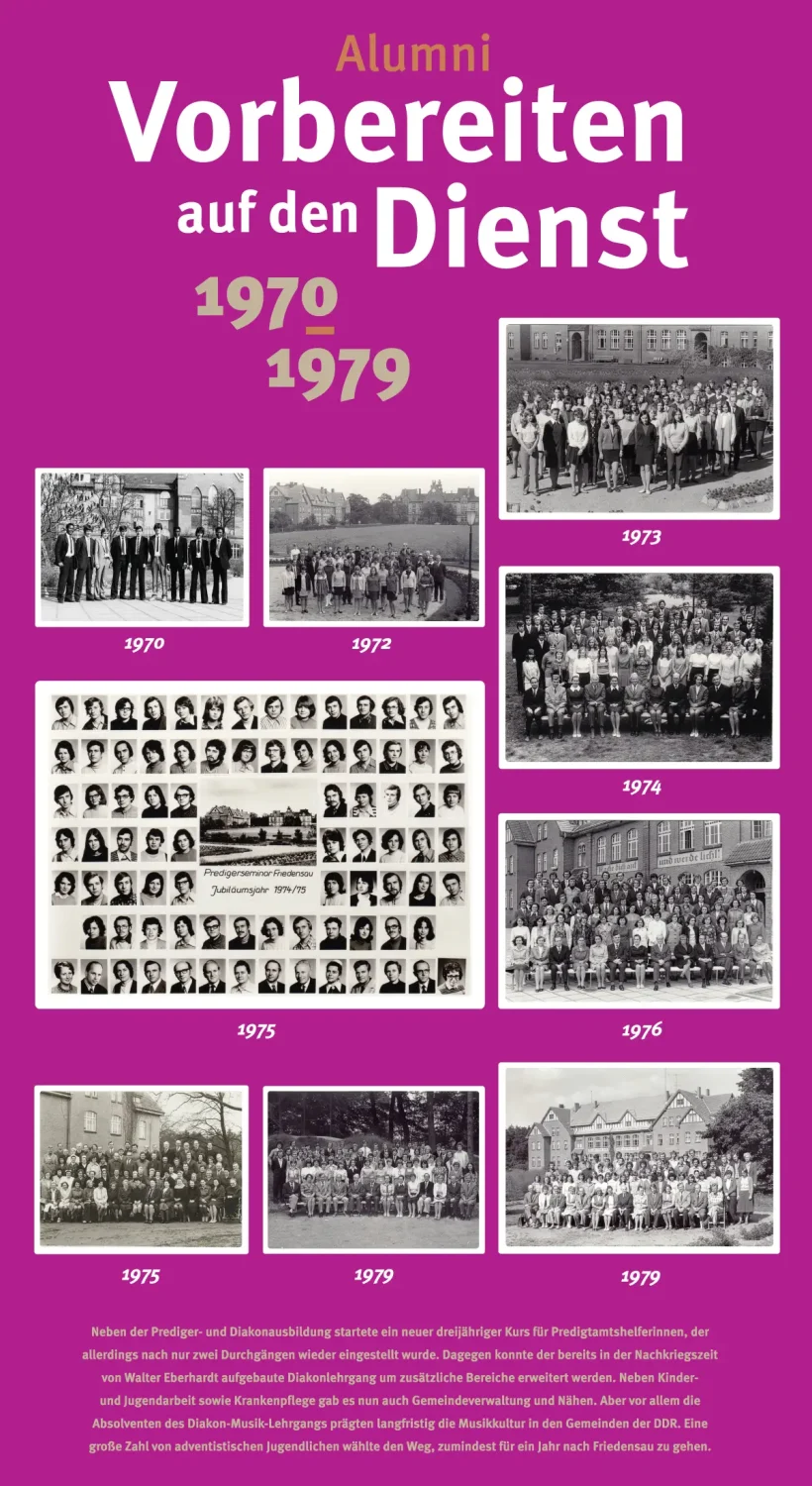
1970–1979
Preparing for Service
Alongside ministerial and deacon training, a new three-year course for women serving as preaching assistants was introduced but discontinued after only two cohorts. In contrast, the deacon training program established by Walter Eberhardt in the post-war period was expanded to include additional areas. Alongside children’s and youth work and nursing, students could now also study church administration and sewing.
Above all, however, graduates of the Deacon Music Program had a lasting influence on the musical culture of Adventist congregations in East Germany. Large numbers of Adventist young people chose to spend at least one year in Friedensau.
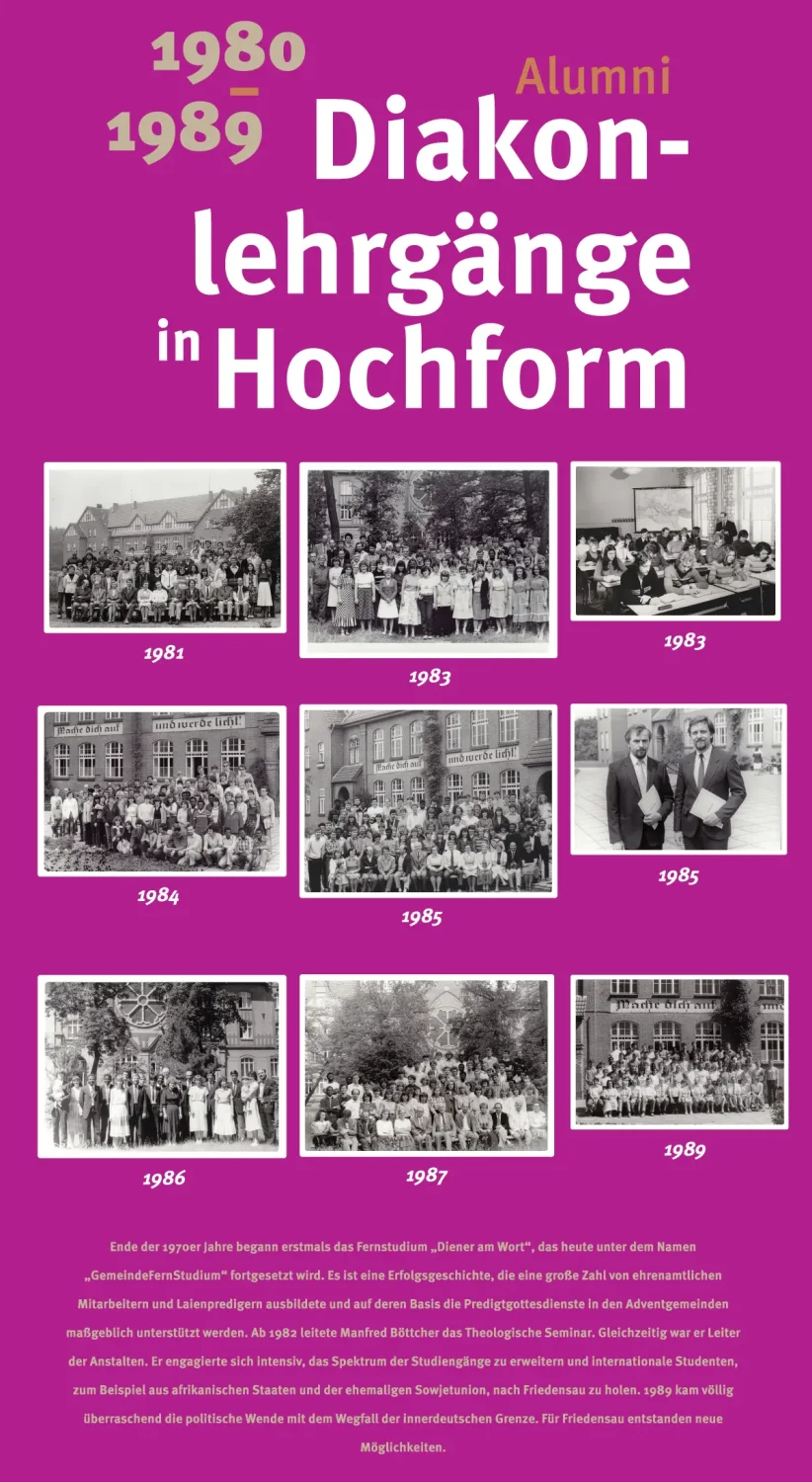
1980–1989
Deacon Training at Its Height
At the end of the 1970s, the first distance-learning program, “Diener am Wort” (Servants of the Word), was launched. Today, it continues under the name “GemeindeFernStudium” (Distance Learning for Congregational Ministry). It became a success story, training many volunteers and lay preachers whose work continues to play an important role in supporting preaching services in Adventist congregations.
From 1982, Manfred Böttcher headed the Theological Seminary. At the same time, he served as director of the institution. He worked intensively to expand the range of study programs and to bring international students to Friedensau, including students from African countries and the former Soviet Union.
In 1989, the political changes came unexpectedly, with the opening of the inner-German border. New opportunities opened for Friedensau.
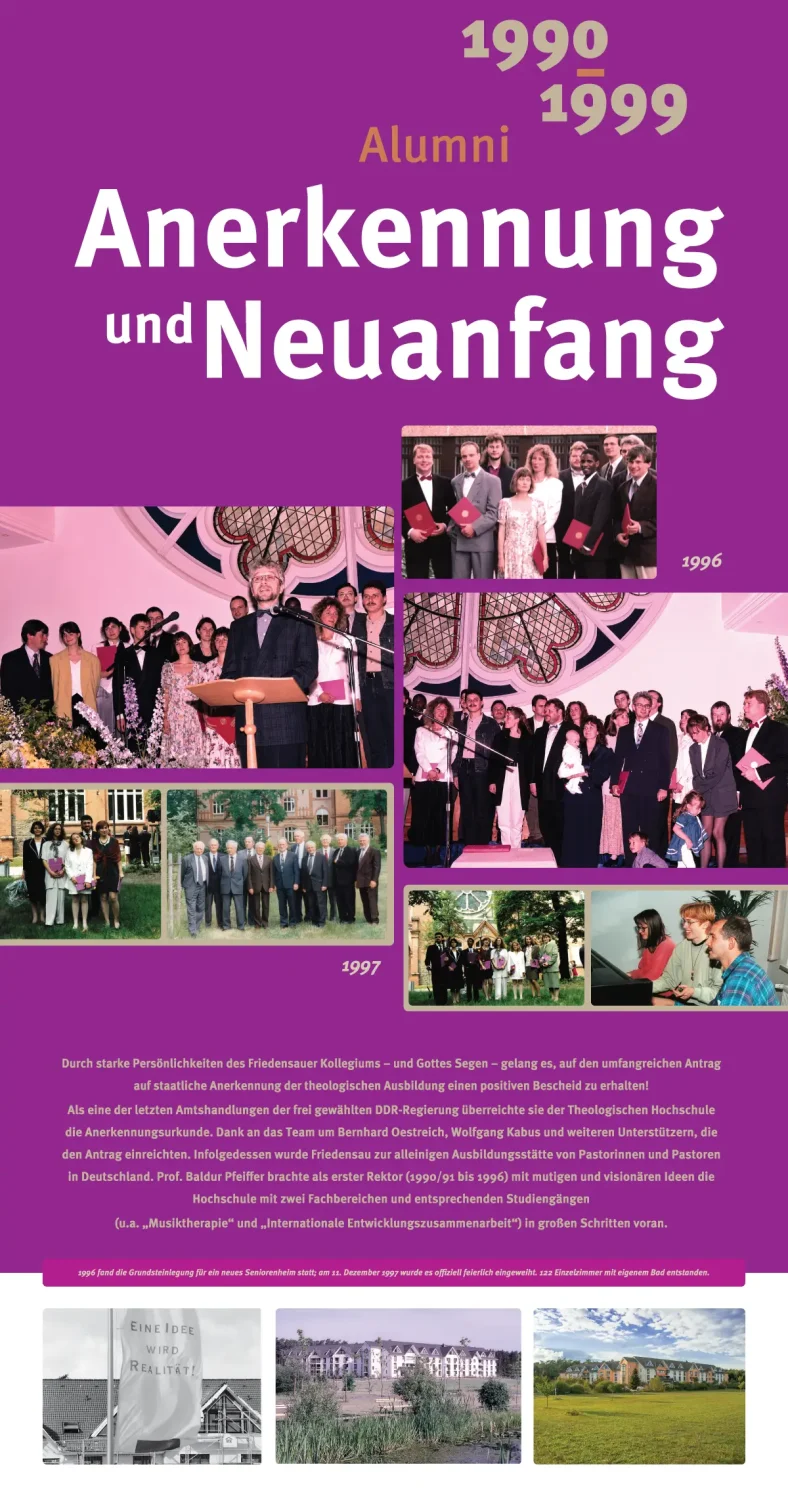
1990–1999
Recognition and a New Beginning
Thanks to the strong personalities within the Friedensau faculty – and God’s blessing – the extensive application for state recognition of theological education received a positive response! In one of the final official acts of the freely elected government of the GDR, the government presented the Theological University with its certificate of recognition.
Our thanks go to the team around Bernhard Oestreich, Wolfgang Kabus and the many other supporters who submitted the application. As a result, Friedensau became the sole institution for training pastors in Germany.
As the first rector, Prof. Baldur Pfeiffer (1990/91 to 1996) advanced the university with courageous and visionary ideas. The two faculties and their corresponding degree programs were developed significantly, including new programs such as Music Therapy and International Development Cooperation.
In 1996, the foundation stone was laid for a new senior citizens’ home; it was officially inaugurated on December 11, 1997. A total of 122 single rooms with private bathrooms were created.
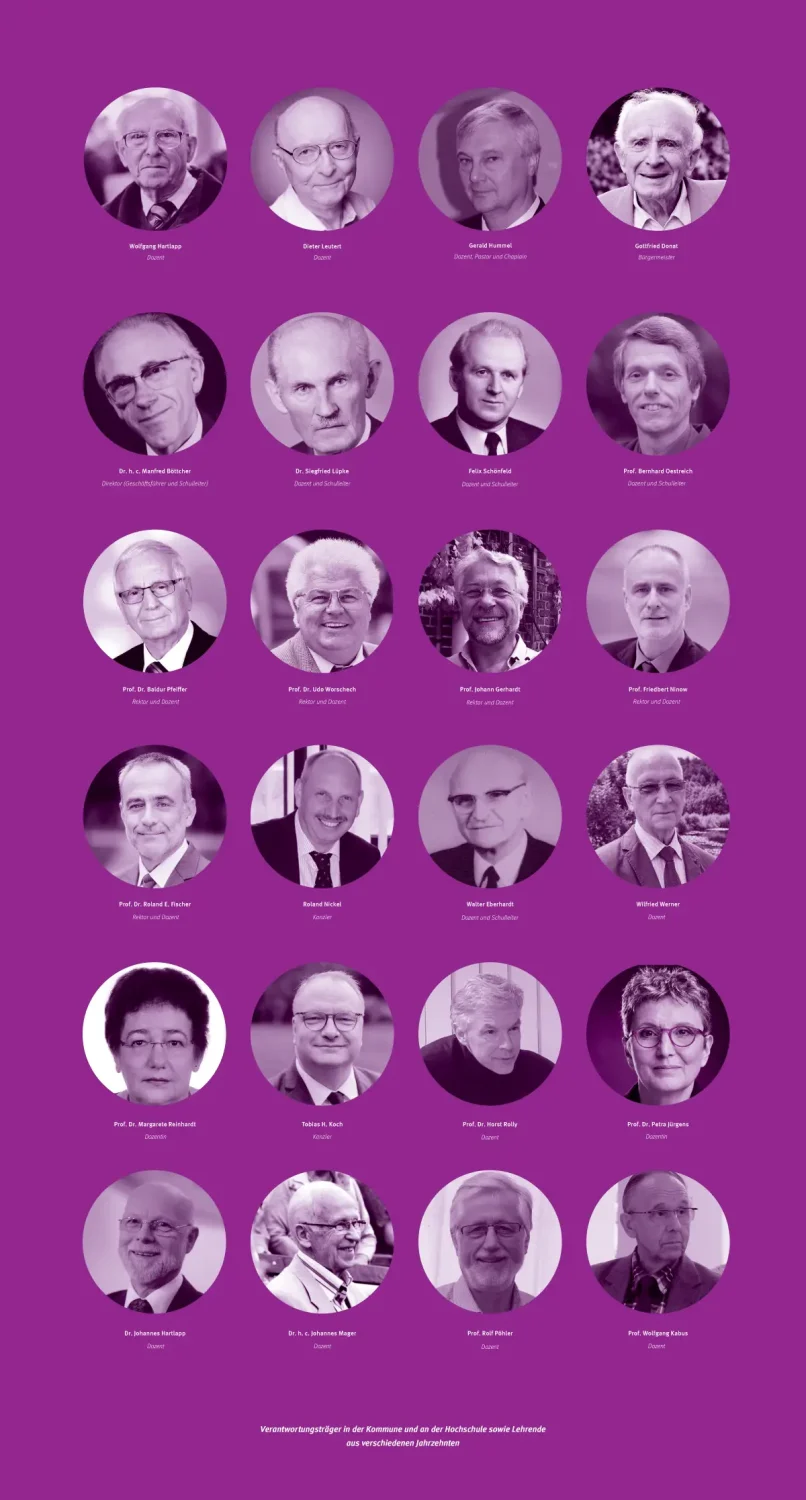
Faculty and Leaders
Teachers and people in positions of responsibility at the university and in the municipality across different decades.
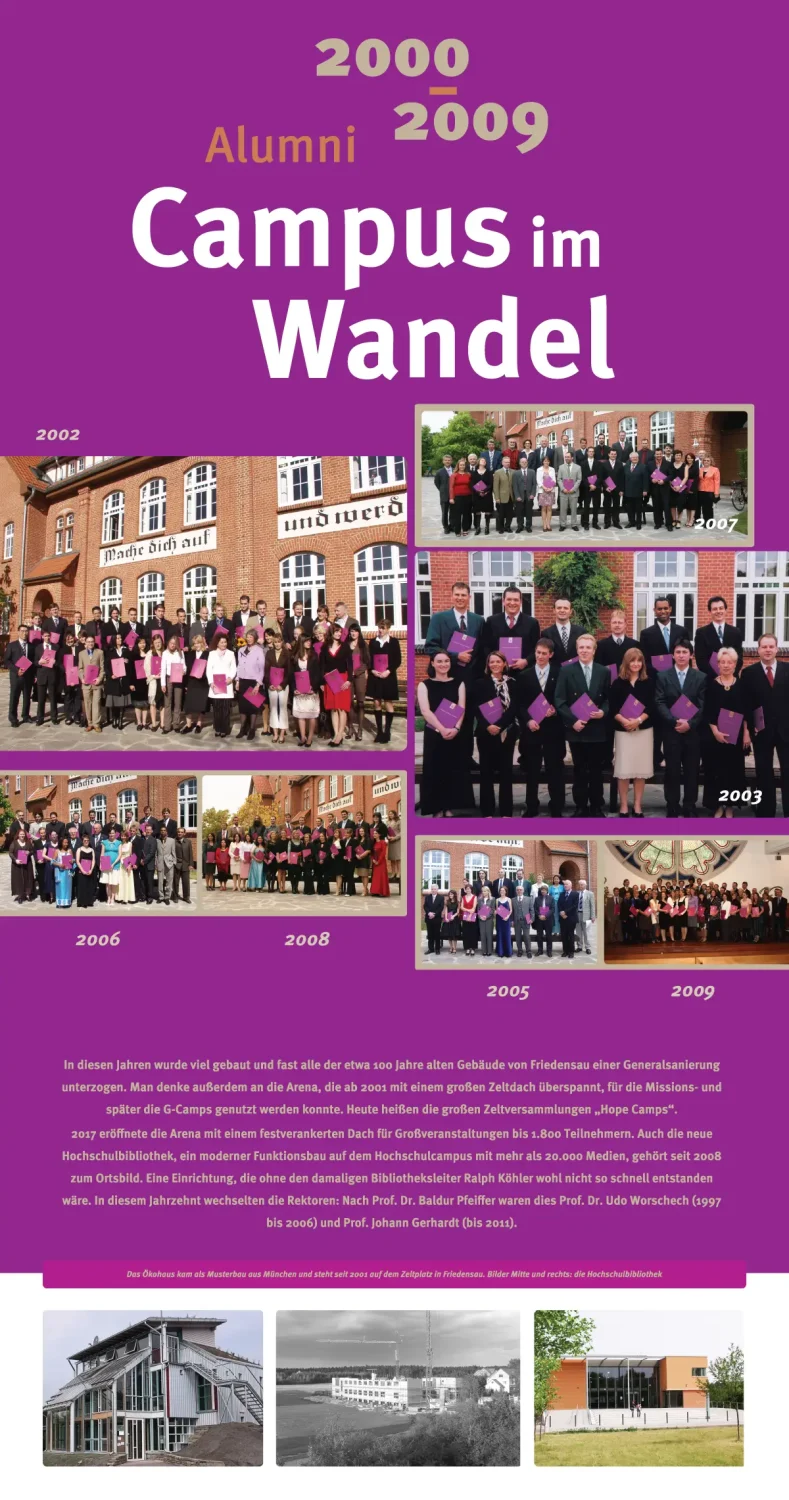
2000–2009
A Changing Campus
These years saw extensive construction work, with almost all of Friedensau’s buildings, many of them around 100 years old, undergoing major renovation.
The Arena also deserves mention. From 2001 onwards, it could be covered by a large tent roof and was used for mission events and later for G-Camps. Today, these large tent gatherings are known as Hope Camps. In 2017, the Arena received a permanent roof and can now accommodate large events with up to 1,800 participants.
Since 2008, the campus has also included the new University Library, a modern building with more than 20,000 media resources. It became part of Friedensau’s landscape thanks in no small part to the efforts of the then library director, Ralph Köhler.
During this decade, the university also saw several changes in leadership. Following Prof. Baldur Pfeiffer, the rectors were Prof. Udo Worchech (1997–2006) and Prof. Johann Gerhardt (until 2011).
The Eco House, originally built as a model project in Munich, has stood at the Friedensau campground since 2001.
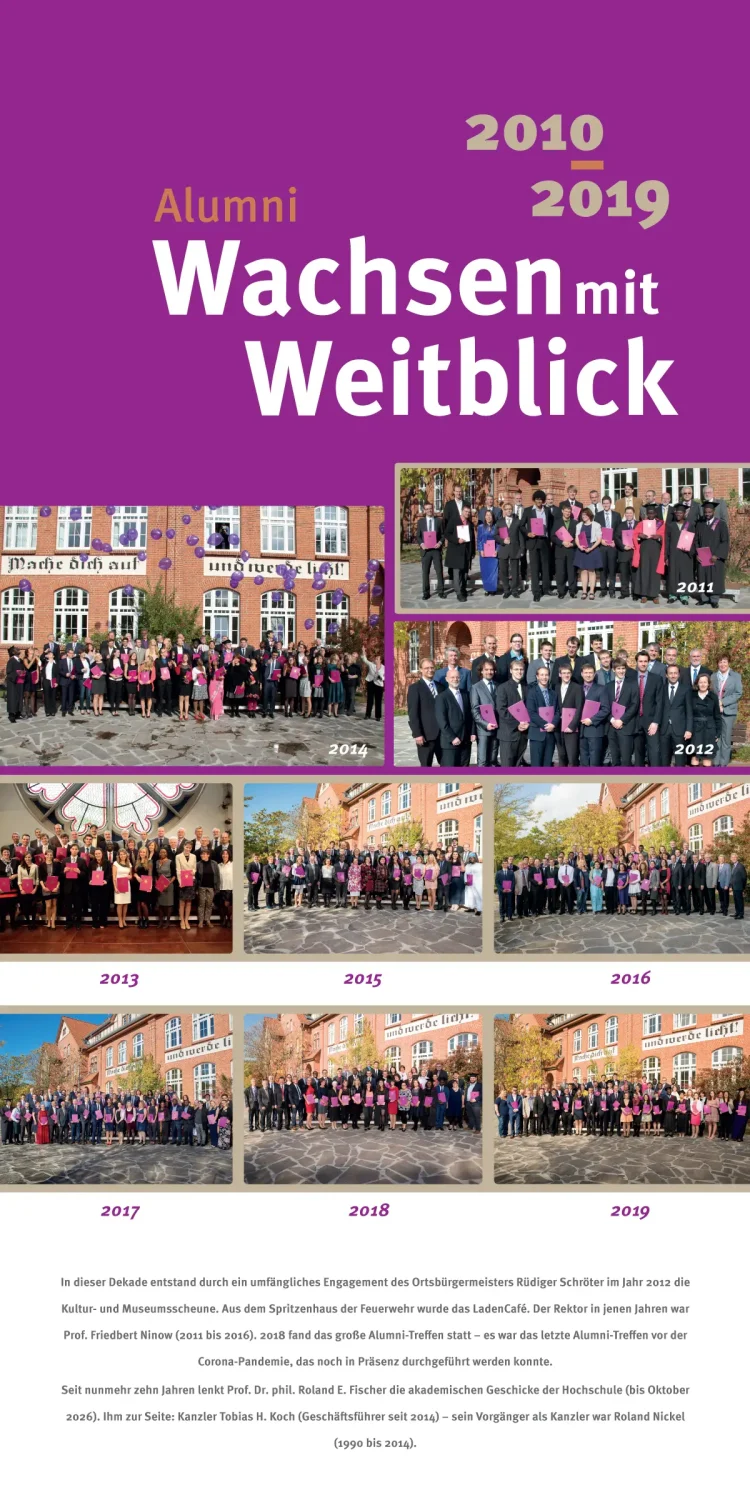
2010–2019
During this decade, the Cultural and Museum Barn was established in 2012 through the extensive efforts of local mayor Rüdiger Schröter. The former fire station was transformed into the LadenCafé.
The rector during these years was Prof. Friedbert Ninow (2011–2016). In 2018, the major Alumni Reunion took place – the last alumni gathering to be held in person before the COVID-19 pandemic.
For ten years, Prof. Dr. phil. Roland E. Fischer guided the academic affairs of the university (until October 2026). Working alongside him was Chancellor Tobias H. Koch, who has served as managing director since 2014. His predecessor as chancellor was Roland Nickel (1990–2014).
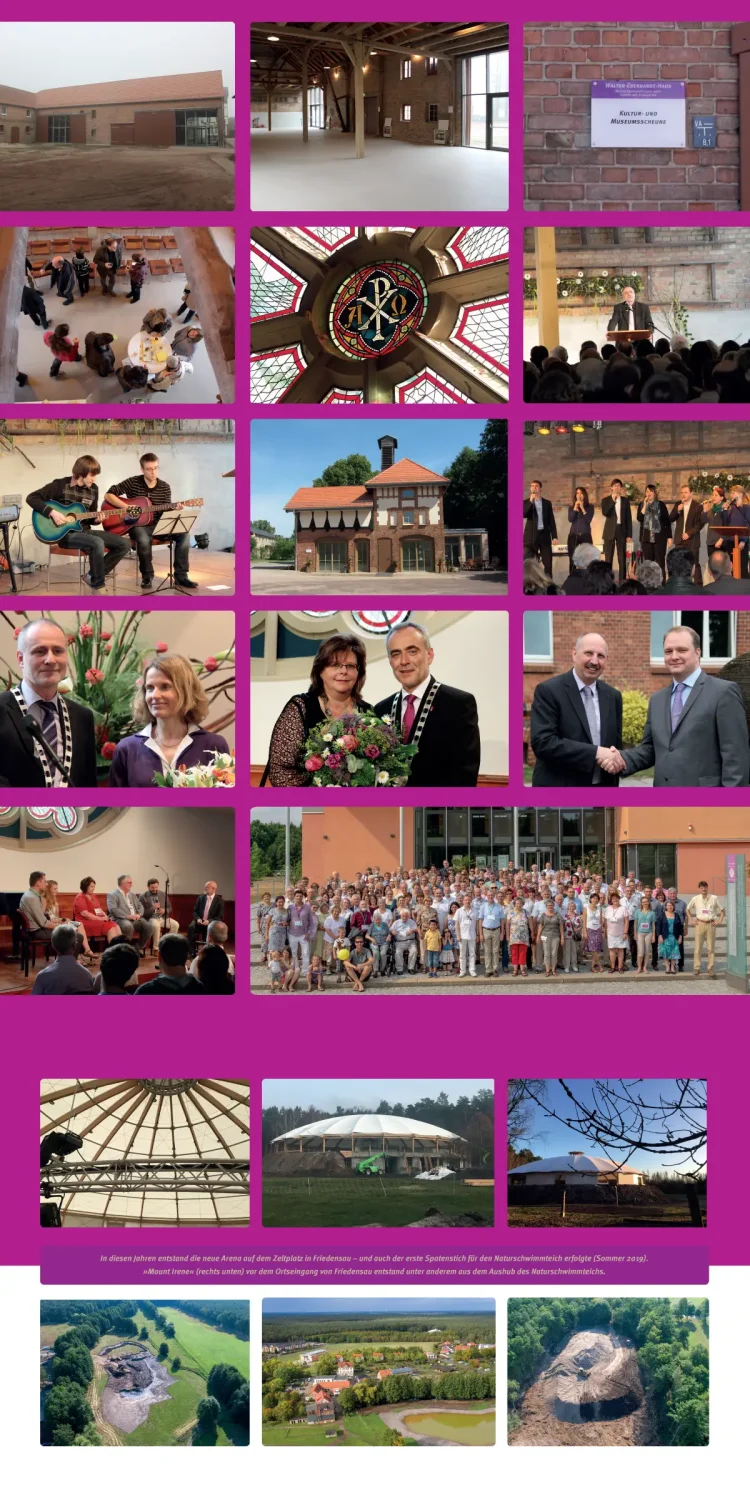
Looking back, it becomes clear that each decade brought many events that were important for Friedensau.
These included the change of rector in 2011, when Prof. Friedbert Ninow took over the “baton” (pictured bottom left with his wife Bernina), and the completion and inauguration of the Museum and Cultural Barn in 2012.
In 2014, Chancellor Roland Nickel handed over his responsibilities to Tobias H. Koch, Ass. jur. (pictured right). In 2016, we witnessed Prof. Dr. phil. Roland E. Fischer (pictured top center with his wife Heike) take the helm of the university as rector.
During these years, the new Arena was built at the Friedensau campground – and the first spade was also turned for the natural swimming pond in the summer of 2019.
“Mount Irene” (bottom right), located at the entrance to Friedensau, was created partly from the earth excavated during the construction of the natural swimming pond.
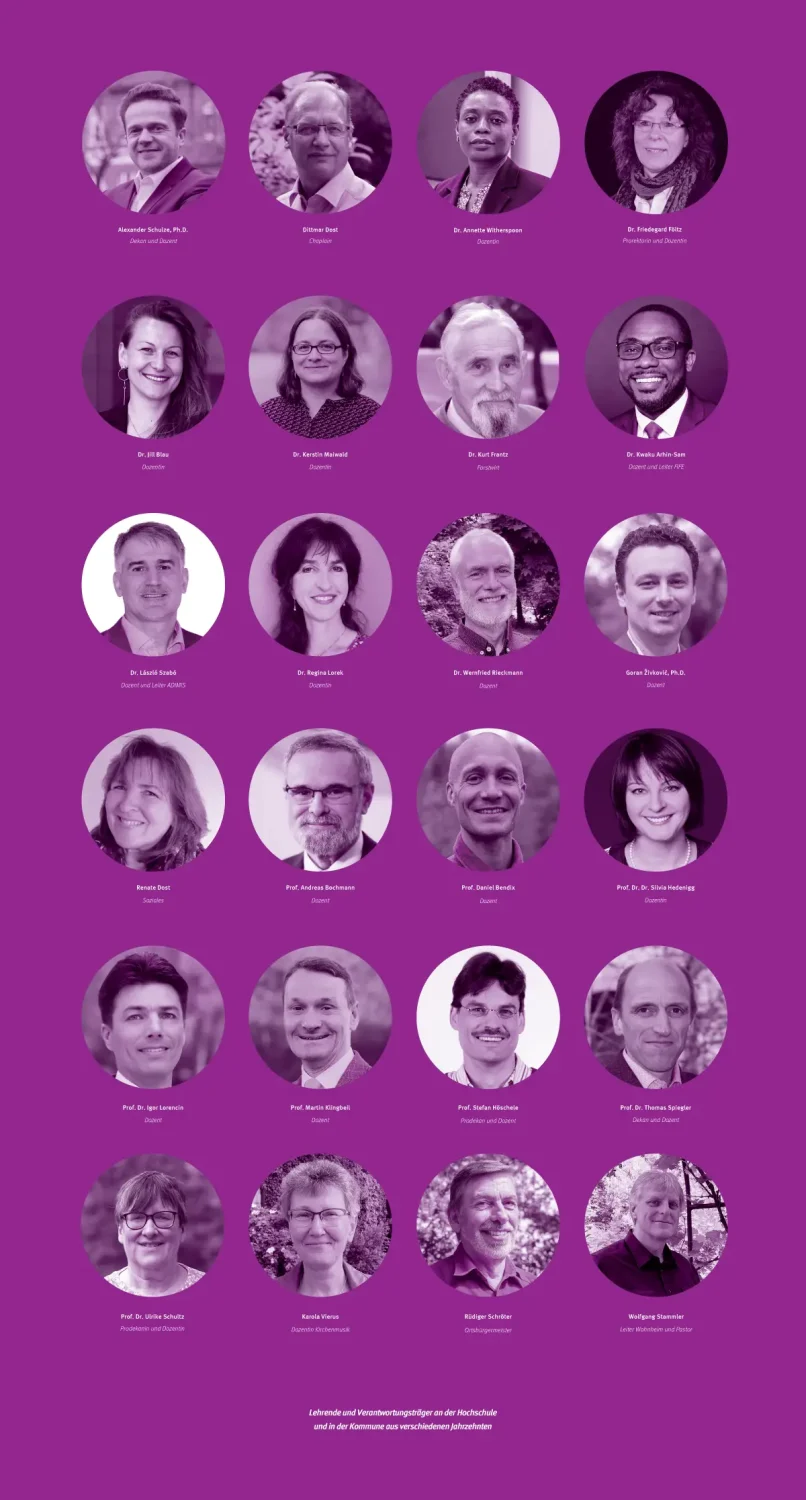
Faculty and Leaders
Teachers and people in positions of responsibility at the university and in the municipality across different decades.
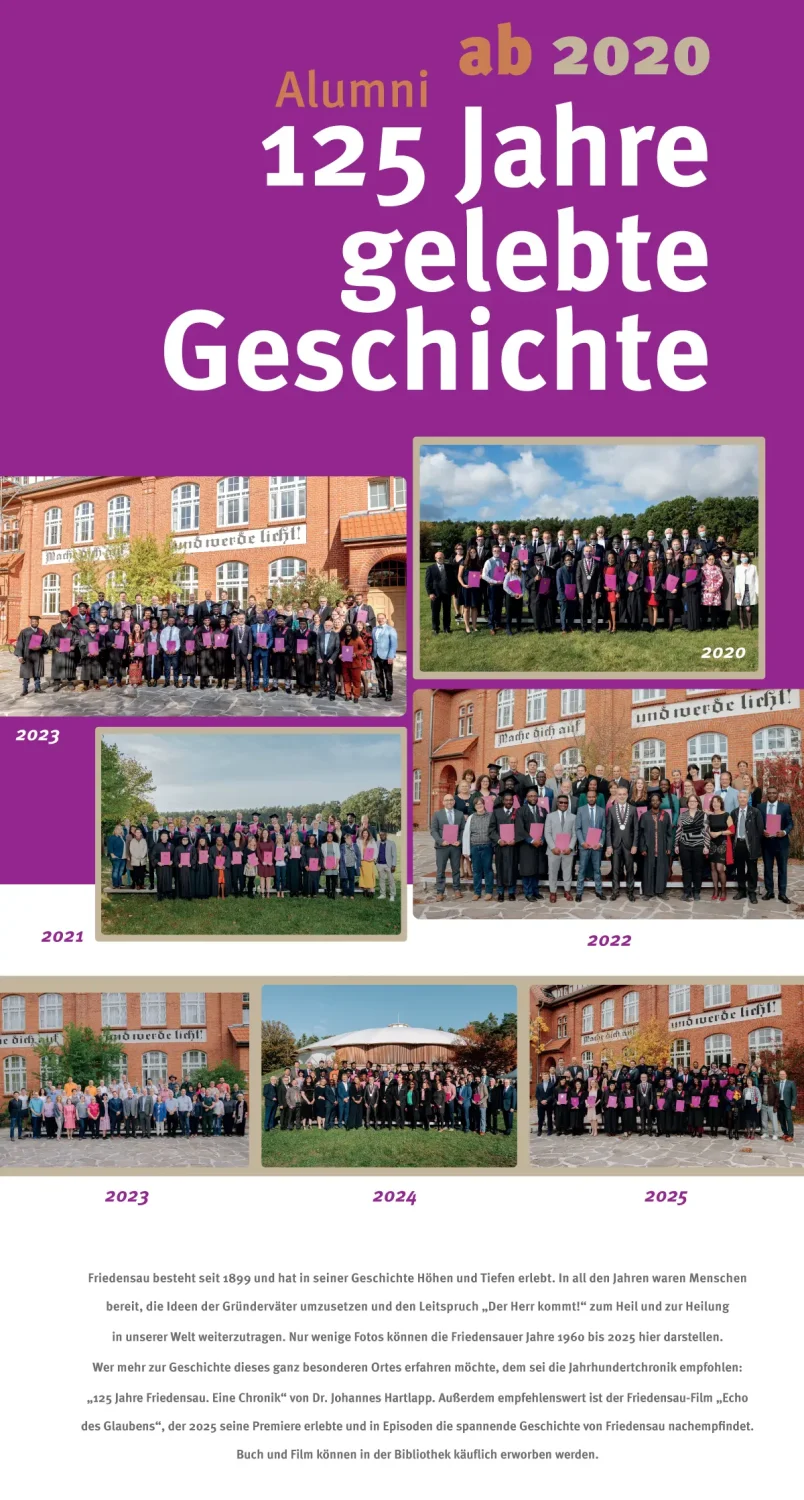
From 2020: 125 Years of Living History
Friedensau has existed since 1899 and has experienced both highs and lows throughout its history. Throughout all these years, people have been willing to carry forward the ideas of the founders and to share the motto “The Lord is coming!” as a message of salvation and healing in our world.
Only a few photographs can represent the Friedensau years from 1960 to 2025. Anyone wishing to learn more about the history of this very special place is invited to explore the centenary chronicle:
“125 Years of Friedensau: A Chronicle” by Dr. Johannes Hartlapp.
Also recommended is the Friedensau film “Echoes of Faith”, which premiered in 2025 and tells the fascinating story of Friedensau through a series of episodes.
The book and film are available for purchase at the Library.
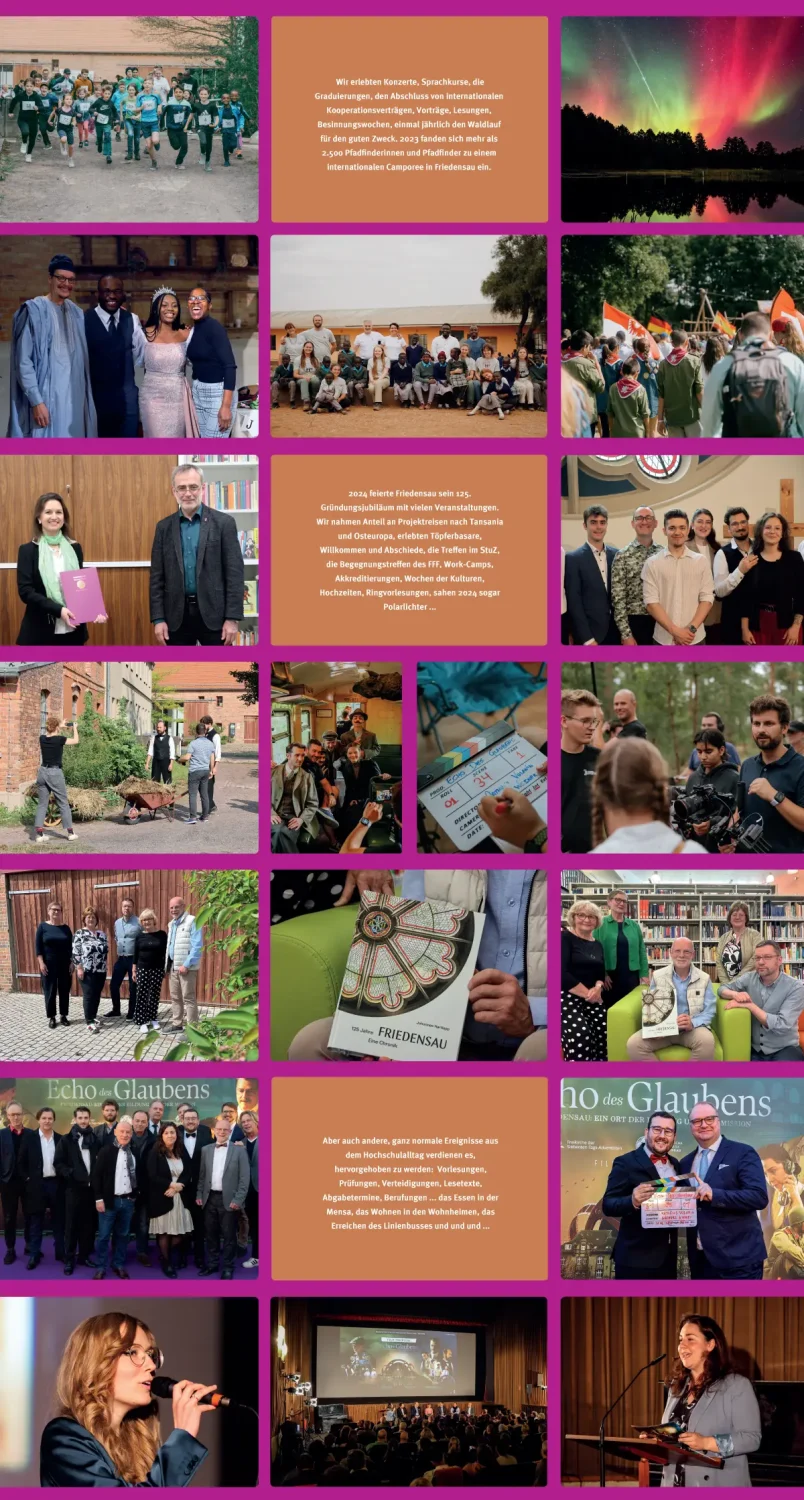
We experienced concerts, language courses, graduation ceremonies, the signing of international cooperation agreements, lectures, readings, weeks of reflection, and the annual charity fun run. In 2023, more than 2,500 Scouts from around the world gathered in Friedensau for an international Camporee.
In 2024, Friedensau celebrated its 125th anniversary with numerous events. We followed project trips to Tanzania and Eastern Europe, enjoyed pottery bazaars, welcomed new faces and said farewell to others, gathered at the StuZ, took part in the FFF meet-ups and work camps, celebrated accreditations, Weeks of Cultures, weddings and lecture series – and in 2024, we even saw the Northern Lights …
But other, more everyday moments of university life also deserve to be highlighted: lectures, exams, thesis defenses, reading assignments, submission deadlines, faculty appointments … meals in the cafeteria, life in the residence halls, catching the local bus – and so much more …