“All real life is encounter.”
25. Mar. 2026 / Science & Research
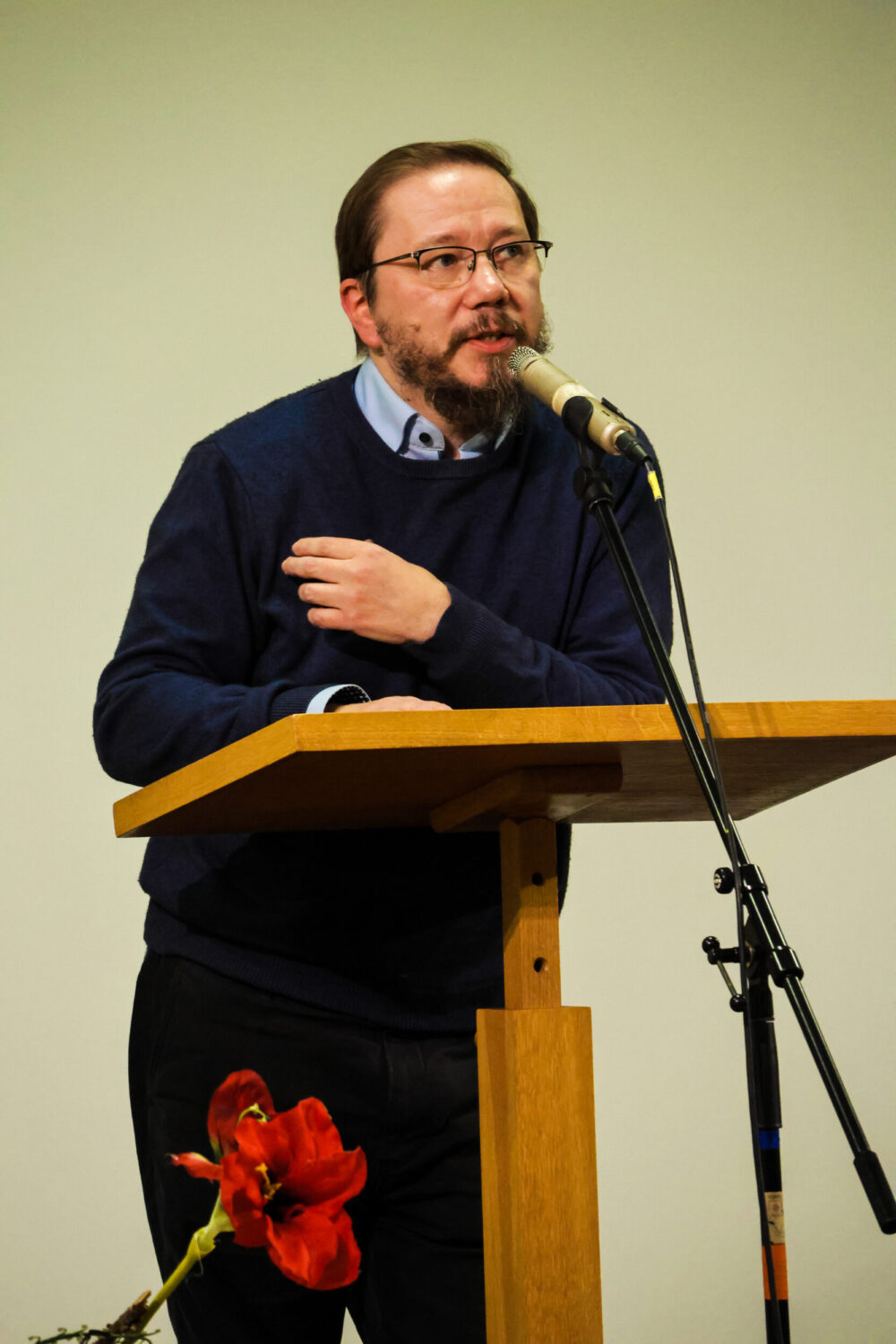
Wonderful Jewish klezmer music filled the air from the loudspeakers in the venerable auditorium of the Theological College. It invited one to dream, made one’s feet tap along, and actually inspired one to dance. This is how Dr Vsevolod Silov, Senior Consultant in Psychosomatic Medicine and Psychotherapy at the Oberhavel Clinics in Henningsdorf, opened his public lecture on “A View of Humanity in Judaism and in Martin Buber” on 14 January 2026.
Is this how one begins such a lecture? Yes, certainly when it comes to Judaism and Martin Buber. For this topic is about far more than the mere conveyance of intellectual information. In keeping with Buber’s principle that “All real life is encounter”, the aim is to connect with one another, to create a resonance in our togetherness, even if not everything is fully grasped cognitively. This was certainly achieved. Otherwise, the lecture dispensed with the media that have otherwise become standard, such as PowerPoint presentations, video clips or even scripts. The spoken word and the encounter with one another took centre stage.
Dr Silov had been invited because the Master’s programme in Counselling also includes a module on the Judeo-Christian view of humanity. My view of humanity, my anthropology, is crucial for counselling and therapeutic processes. It makes a difference whether I understand human beings, for example, as biochemical machines or as beings brought to life by God’s breath (Hebrew: ruach) (Hebrew: nephesh). It makes a difference whether I perceive human beings as self-contained systems or as beings designed for relationship.
In his lecture, Silov introduced us to the world of thought and experience of Jewish Hasidism – a form of Jewish mysticism that originated in Eastern Europe and which also repeatedly fascinated and was explored by Buber – a world that was largely unfamiliar to most of the audience. In doing so, he also explained various Hebrew terms for ‘human being’, each of which places its own distinct emphasis on a view of humanity. An illuminating diversity that takes us to the limits of reason.
Silov then turned our attention to Martin Buber, who was not only a well-known philosopher of religion but, in essence, a polymath of the early 20th century. He made an enormous contribution to psychotherapy in particular, which also makes him of interest to the fields of pastoral care and counselling. Silov himself wrote his doctoral thesis on this subject and has produced numerous publications and lectures.
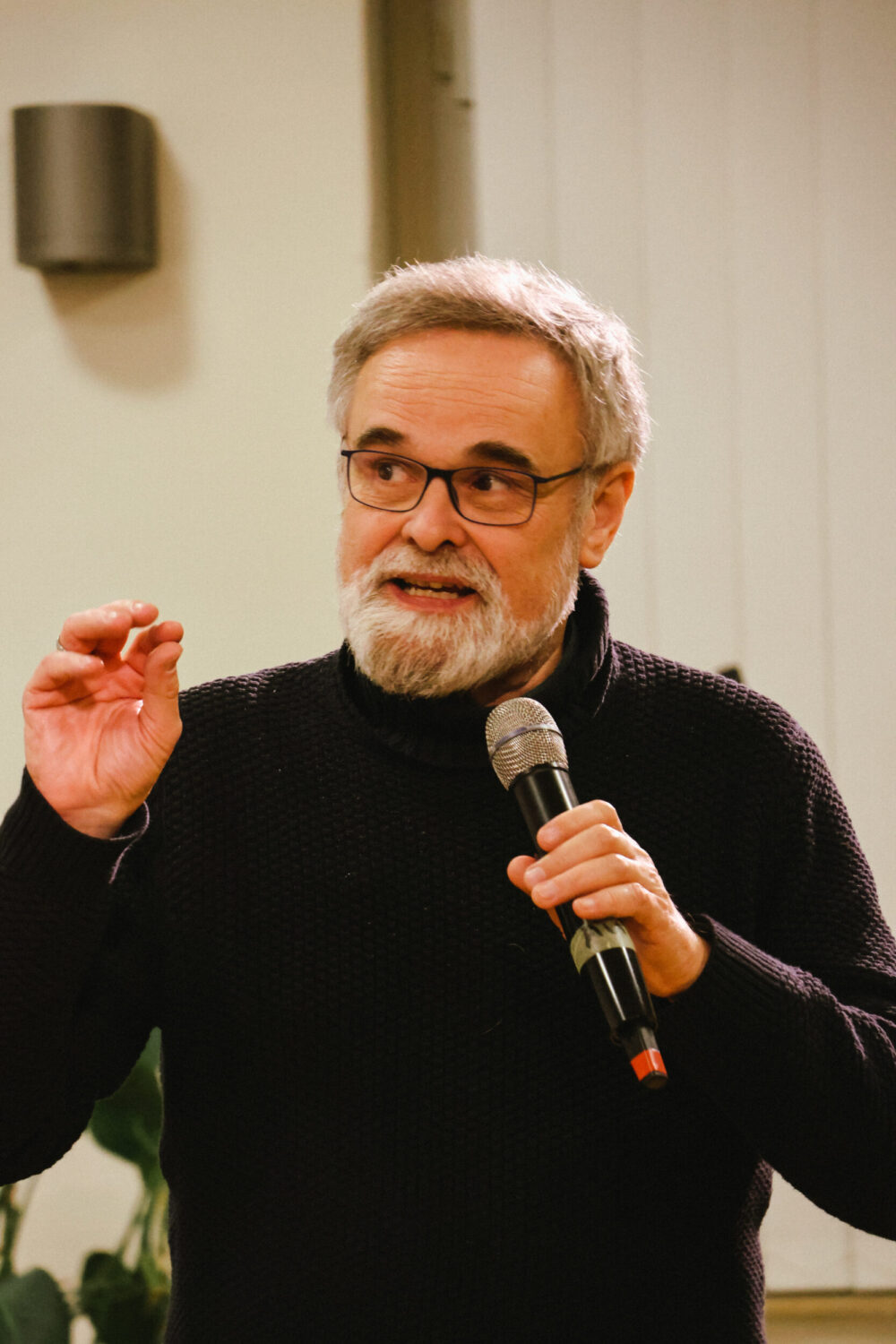
The audience’s interest in Buber was palpable, as evidenced by the subsequent Q&A session and discussion. Even where not every detail was fully grasped intellectually, it was nonetheless an encounter and a genuine experience. An enriching experience for the students, lecturers and guests in attendance.
“All real life is encounter”
This is perhaps the best-known statement by the Jewish religious philosopher Martin Buber (1878–1965). In his approach to a philosophy of dialogue, he also formulated: “Man becomes I through the Thou.” We need one another, grow and mature through one another, and only become fully human through encounter with another. This approach is already grounded in the story of creation: “Let us make humankind …” (Genesis 1:26ff), but also: “And the man gave names to all the livestock and the birds of the sky and all the animals of the field. But for Adam he found no helper suitable for him” (Genesis 2:20).
Buber & Rosenzweig
Equally well-known and well worth reading is the translation of the Hebrew Bible by Martin Buber and Franz Rosenzweig, *Die Schrift*, which, in very powerful language and with some unusual neologisms, attempts to convey the stylistic character of the Hebrew Bible into German.
Prof. Andreas Bochmann, Ph.D.
Professor Emeritus of Counseling at Friedensau Adventist University
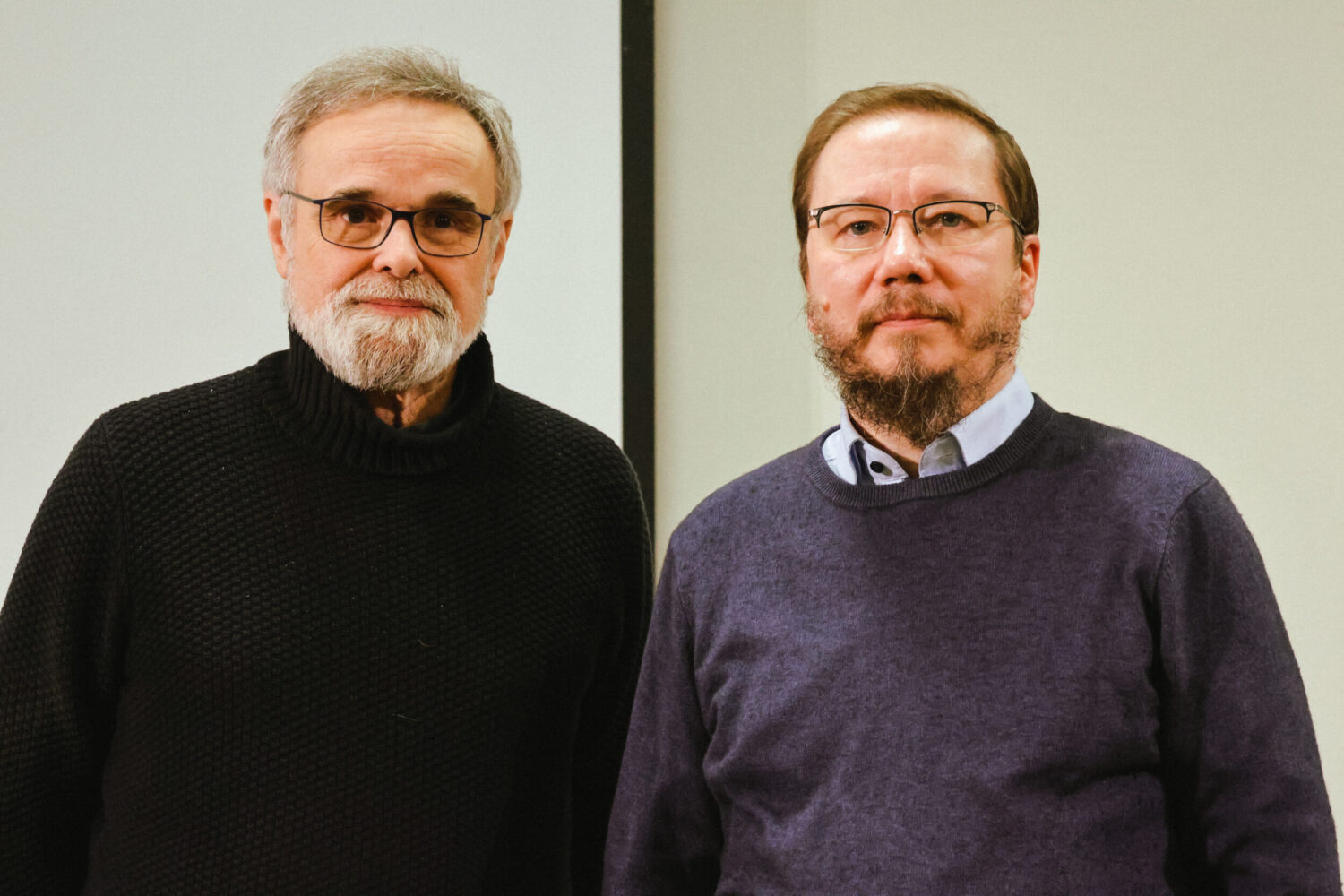
All Photos here: FAU | Adrien Mogisha