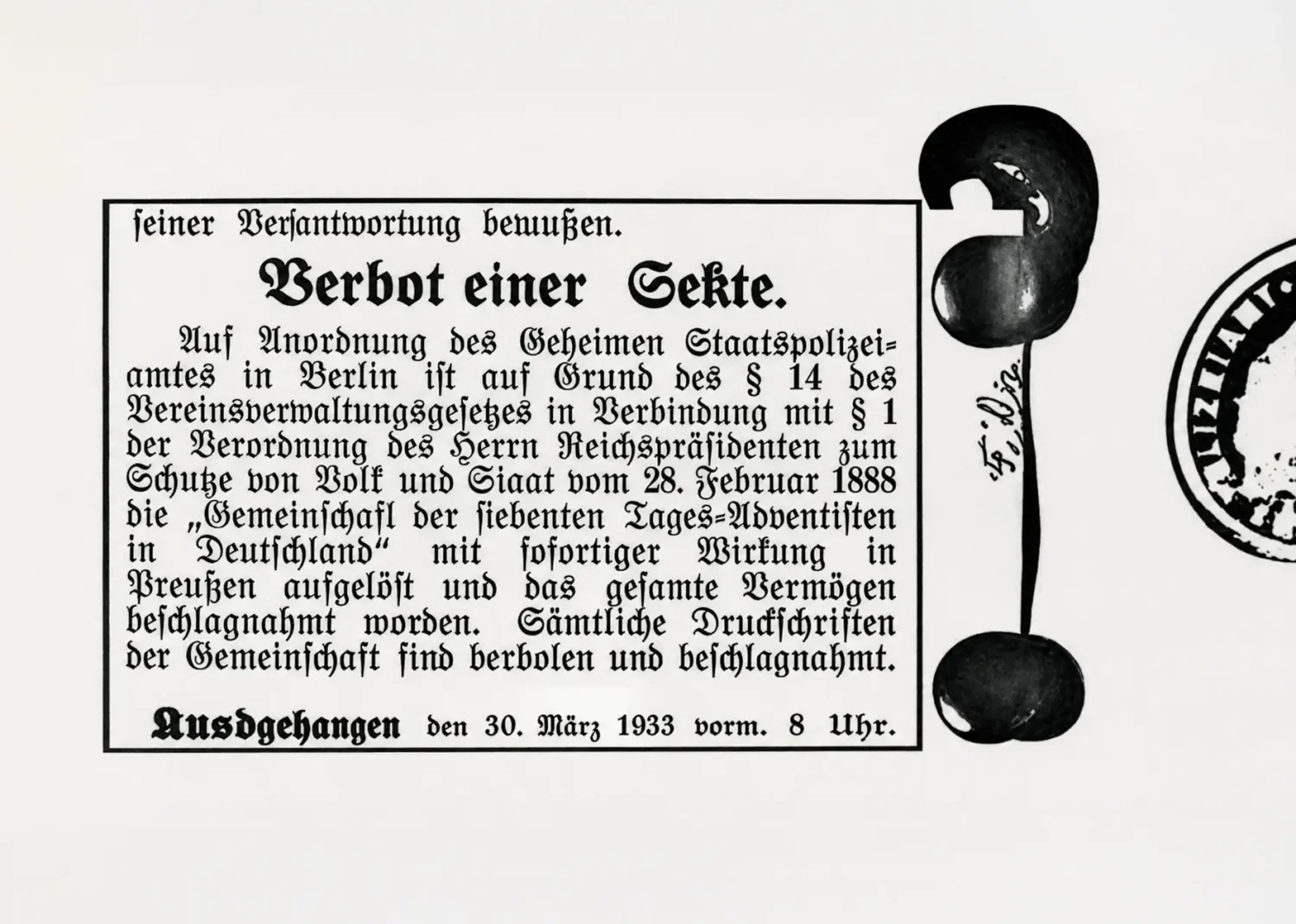
A courageous protest against the ban on the Adventist Church in 1933: Pastor Rudolf Stein
08. Jul. 2026 / Science & Research
On December 28, 1933, the Gestapo in Berlin issued a circular to all non-Prussian states stating that, pursuant to § 14 of the Police Administration Act in conjunction with § 1 of the Reich President’s Ordinance for the Protection of the People and the State dated February 28,1933, the Seventh-day Adventist Church had been dissolved and banned within the territory of the Free State of Prussia. At the same time, all Adventist publications were to be confiscated and banned. With typical German thoroughness, it took three more days before the ban also took legal effect in the Free State of Brunswick. However, the police authorities acted immediately upon receiving the letter from Berlin; as early as November 29, 1933, the Political Police appeared before the Brunswick pastor Rudolf Stein and informed him that the church had been banned and its assets were to be confiscated.
Rudolf Stein—a graduate of Friedensau
While the community’s offices—especially the headquarters of the Central European Division in Berlin—were frantically searching for members who had good connections to people in high-ranking positions or to the NSDAP—for example, there was an Adventist in Munich with party membership number 112, a so-called “old fighter”— But the Braunschweig pastor took a different path, one that was unusual for the time: he wrote a letter of protest to the Braunschweig Ministry of the Interior. I have not yet found anything similar in the archives! While the church leadership sent letters to the Protestant Reich Bishop, the NSDAP party leadership, the Prussian Ministry of the Interior (as Hitler’s deputy), and other prominent figures, requesting an explanation or the reversal of the police measure, Rudolf Stein protested! That is why it is worth remembering this man, who received his training in Friedensau in 1908 and 1909, then worked as a pastor in Frankfurt am Main, and from 1911 served as a missionary in what was then German East Africa and in Abyssinia (Ethiopia).
With Great Courage Against the Regime
In his letter dated December 4, 1933, to the Minister of the Interior of the Free State of Brunswick, Rudolf Stein describes how all of the community’s meeting places in the state of Brunswick had been sealed, the funds confiscated, and his work as a preacher brought to a standstill. “A great sense of dismay has settled upon the believers entrusted to my care, especially since I have received no explanation from the Minister.” For this reason, he is now addressing this representative of the state with two questions:
“1. Has the provision on freedom of religion and conscience been repealed in Braunschweig?
2. Have we, as Seventh-day Adventists, ever engaged in political activity against the government? Are we being accused of such an offense? If so, we are ready to defend ourselves at any time!
Since the implications of the Braunschweig government’s actions are so far-reaching, and since fundamental questions of life and conscience are being raised, I feel compelled to raise a solemn protest from the deepest recesses of my conscience!
I protest in the name of Jesus, the Lord of my faith and conscience, who was crucified because of the intolerant spirit of His time!
I protest in the name of all the martyrs who bore witness to and died for freedom of faith and conscience!
I protest in the name of the most fundamental human right—the right to be the master of one’s own conscience.
I protest in the name of Luther, the defender and restorer of freedom of faith and conscience!
I protest in the name of the Augsburg Confession, Article 28!
I protest in the name of all Protestant Christians whose consciences are bound to biblical principles!
I protest in the name of our esteemed Reich President von Hindenburg, whose wish is that Christ be preached in Germany!
I protest in the name of our highly esteemed Reich Chancellor Hitler, who has promised the German people that no religious conflict shall arise. Moreover, he—and with him millions of devout Christians—knows that form does not convey substance unless we include the whole Gospel!”
These were unusually clear words during a time of “Gleichschaltung” that tolerated no protest whatsoever and persecuted all dissenters with violence. Anyone who appealed here to freedom of faith and conscience ran the risk of experiencing the full intolerance of the Nazi state firsthand. Rudolf Stein apparently accepted that risk. Or was it trust in the words of leading figures in the Nazi state who—at least as late as 1933—spoke of freedom of religion and conscience in order to win over Christian voters? It seems that many believed these words, which, however, were soon proven false by reality. Be that as it may, the protest was unusually clear for Adventist circles.
Letters Supplemented with Adventist Literature
The letter of protest was followed by explanations intended to prove that “there is absolutely no basis for the suspicion that [Adventists] are enemies of the state. On the contrary, the facts prove that the Adventist Church, in particular, is united in its commitment to conscience and stands, with the fullest conviction and all its strength, in the service of the people and thus also in the service of the government.” As proof of this, Rudolf Stein sent two brochures about the Adventist churches and their social activities along with the letter of protest: Wilhelm Mueller, *What You Need to Know About the Adventists*; and Huld Jost, *What Do the Adventists Do in Social Welfare?*
At the same time, Stein recalled the words of Hitler’s deputy Rudolf Hess—which were widely circulated in Christian circles—who, in the summer of 1933, had proclaimed freedom of conscience in matters of faith as a position of the party and the government . “We remain,” Rudolf Stein continued, “in all sincerity and from the bottom of our hearts, willing to place all our strength at the complete disposal of the German people in every respect and in every possible way. In my opinion, Germany must not allow itself to provoke a crisis of conscience during this time of reconstruction and the fight against the cultural crisis.”
From today’s perspective, these words already reveal how strongly propaganda had influenced people’s thinking and language—as well as their belief in the “good” leader of the new Germany—after only a few months. And yet, the courage with which Rudolf Stein raises his voice here and ultimately formulates his request cannot be overlooked: “I hereby submit a request to the esteemed Brunswick government to reopen our establishments and release the confiscated funds.”
The Preacher of the Convent of Braunschweig, Helmstedt, Wolfenbüttel, and Königslutter
On the same day, Rudolf Stein sent a second letter to the same addressee to “draw attention to certain abuses on the part of individual officials that occurred during the closure of the Helmstedt meetinghouse of the Seventh-day Adventist Church.” Officials had forced their way into the home of the Helmstedt church elder when only minor children were present, demanded keys, and confiscated the elder’s private library. “I ask the Minister to ensure, among other things, that the private property is returned to its owner.”
Even before the letters had elicited a response through the usual administrative channels, Rudolf Stein wrote again for the third time, this time in a handwritten letter dated December 7, 1933. One can almost sense from the letter that it was written in haste. The author reports briefly and concisely that he had received notification from his superior agency that the ban on Seventh-day Adventists in Prussia had been lifted. “In the pleasant expectation that the Braunschweig government will conform to this decision, I am informing you of the above.” It was certainly not this letter that brought about this change; but on December 7, the government in Braunschweig did indeed lift the ban, and as early as the following Sabbath, December 9, 1933, the congregation in Braunschweig was once again able to hold worship services in its church hall.
Controversial, Yet Successful
But the correspondence did not end there. While in other places people sometimes thanked state representatives with effusive words for rescinding the decree, Rudolf Stein spoke up again on December 13, 1933, with a letter to the Minister of the Interior. He confirmed that, now that the ban on the congregation in Prussia had been lifted, services could once again be held in Braunschweig as well, “since you granted permission to do so.” Without offering any further words of thanks, he complained: “However, to this day I have not been able to serve the congregations in Königslutter, Helmstadt, Schöningen, and Wolfenbüttel . Since these congregations also wish to receive pastoral care from me, I ask the Minister to take immediate steps to ensure that the previous situation is restored in the aforementioned locations as well, so that I may carry out my ministry.”
Archives provide information on many details, even minor ones
There is no evidence of a direct response from the Brunswick Minister of the Interior, although a handwritten note on the second letter confirms that the letter was not filed away but that the police had been asked to provide a report on the events in question in Helmstedt. However, the minister’s annoyance at the preacher’s bold and self-assured demeanor could be indirectly inferred from a letter dated December 27, 1933, from the Reich Ministry of the Interior to the Prussian and Brunswick Ministries of the Interior. In it, the Ministry refers to a letter from the representative of the Adventists in Germany, Emil Gugel, dated December 20, 1933, which states that there were some places where Adventist meetinghouses and the private property of preachers had not yet been returned. Interestingly, of the twelve cities mentioned, all except Neuruppin are located in the Free State of Braunschweig. The church chronicles of the Adventist congregations in Blankenburg and Hasselfelde (which at the time belonged to Braunschweig) indicate that the restrictions were not lifted until March 1934. Was this a reaction to Rudolf Stein’s courageous stance? We do not know, but the missionary and preacher Rudolf Stein belongs to the small group who, during the Nazi era, had the courage to publicly demand the right to freedom of religion and conscience. That should not be forgotten.
Dr. theol. Johannes Hartlapp